When I first came across this issue, it was in one of those “sale” shelves. Apart from Batman himself, I wasn’t as intimitately familiar with the rest of the Batfamily just yet. The cover intrigued me, though, and a few pages in, I was sold.
In hindsight, it was ridiculously cheap for such a gem (plus, in fairly good condition)! It’s one of the first single issues I’ve ever bought, and one of the first to solidify my growing addiction to moments of Batfamily angst.
So, I guess the cover can clue you in about what this issue might be about, but here’s a little backstory (and some spoilers):
Outsiders #1 is set a while after the Titans parted ways following the loss of Lilith and Donna Troy (Wonder Girl). Roy Harper (Arsenal) approaches Dick Grayson (Nightwing) about forming a new team of superheroes. Dick, still brooding over their loss, is uninterested. It’s clear that he isn’t ready for the emotional burden of leading a team, then putting their lives at risk again.
Roy reminds him why they formed the Teen Titans in the first place (to be heroes in their own right, and not just sidekicks), and that this time around, they didn’t have to be as emotionally invested as they used to be. They didn’t have to be a “family” like the Titans were, just a team.
Reluctant but convinced, Dick eventually becomes their leader.
Note: Now, if the “Outsiders” sound familiar to you, remember that Batman led his own version of the team?
Anyways…
“So… who pays for this team?”
In the previous issue, Outsiders #20 (2005), following Metallo’s attack on the Outsiders’ headquarters, Indigo makes an incidental finding in the wreckage: the high-tech cables hidden in the building walls aren’t supplied by Optitron (the corporation they believe to be financing their vigilante operation), but by one with much deeper pockets…
Now, onto the current issue again (and a little more backstory):
“They keep close tabs, but they have allowed the team to be autonomous.”
Optitron, which was once merely a syndicated cable company, eventually acquires three of the largest cable companies in the world. As a way of giving back to the people for its immense success, the corporation becomes involved in global philanthropy. To step it up a notch, it funds a crime-fighting unit of superheroes (yes, the Outsiders).
And, by “this”, it’s safe to assume that he means Bruce – to put it lightly – interferes. Ask any member of the Justice League – he’s notoriously controlling!
Now, you’d think that Dick would be more grateful, right? While other vigilantes conduct their operations in cramped hole-in-the-walls, worrying about their day jobs to carry on their night ones, he and his teammates are gettin’ paid.
But, this is a father-and-son, not benefactor-and-beneficiary, kind of issue. It has nothing to do with money. As it usually is between Bruce and Dick, it’s a matter of principle.
So, brace yourself for some DramaTM, Wayne Manor style…
“What the hell is the matterwith you? I mean, aside from the obvious!”
So, here’s Dick, dropping some heavy truth bombs…
Part of Bruce’s parenting style is to absorb his children’s rage (over him, over anything), then channel it into a teaching moment (eventually). As long as they’re not in the middle of a life-threatening scenario, he’ll hear them out.
He’ll let them say what they want to say, how they want to say it.
Then, he’ll seem detached and uncaring. But, see, he’s not exactly Mr. Heart-on-His-Sleeve. When you’ve become as hardened by years of pain and loss such as him, it becomes a habit to tuck any semblance of vulnerability away.
It doesn’t mean he doesn’t love his children – he clearly does,1000% yes – but sometimes silence is all he has to offer. A moment to listen. A mind that isn’t racing towards the next case. Because he knows that there are problems a utility belt just can’t solve. (Plus, he’s not always the best at words when emotions are concerned.)
He has his moments when he’ll let his guard down, too. When he’ll act like their father-father, not just their mentor-father. A tight hug. An affectionate hair tousle. Forgoing patrol to watch a movie (*cough* Jason *cough*). The little things. Rare, perhaps, but they do happen.
But, yeah, then there’s moments like this, too (where we’re extra thankful that Alfred’s around):
“As hard as it may seem, Dick, I saw the Outsiders as a good idea. I believed in you.”
Anytime Bruce keeps something from him, Dick gets hurt. Because he’s always thought highly of Bruce and the bond that they share is sacred to him.
Now, keep in mind that part of why Dick became Nightwing was to shed his sidekick persona. Much of his adult life has been spent trying to step out of Bruce’s shadow and become his own kind of superhero.
So, understandably, he feels betrayed. In his mind, Bruce lied to him and is still closely keeping tabs on his endeavors.
(That act of “omission” on Bruce’s part? I guess we can chalk it up to his habit of not-needing-to-explain-himself.)
For some reason, the next set of panels reminds me of that episode from the first season of Young Justice in which Bruce requests a private meeting with Kaldur’ahm (Aqualad) in which even Dick (then Robin) isn’t invited. Dick gets jealous and takes it out on the (concrete?) gym wall. By the end of the episode, Bruce makes it up to him by challenging him to a one-on-one basketball match – undivided attention! – which Dick gladly accepts.
Bruce’s opinions matter very much to Dick, whether the latter agrees with them or not. In both instances (Young Justice and this issue), he’s expressing his insecurity (though, he seems to be denying it in the fourth panel). Where does he stand with Bruce? (A question which every Batfamily member has probably asked at least once in his or her life.)
“You expect too much of me.”
Bruce. Ever the pragmatist. Always punishing himself with reminders of his failures, of people he wasn’t able to save.
And, Dick, ever the optimist. Always trying to give others the benefit of the doubt.
For the purpose of closure: At the end of the issue, we find out that it wasn’t actually Bruce who’s been giving Roy intel all this time, but Slade Wilson disguised as Batman.
Bruce and Dick… they’ll have these fits of rage, then calm down as if nothing happened. Neither needs to say “It was my fault” or “I love you” or whatever. It’s all just kind of understood somehow.
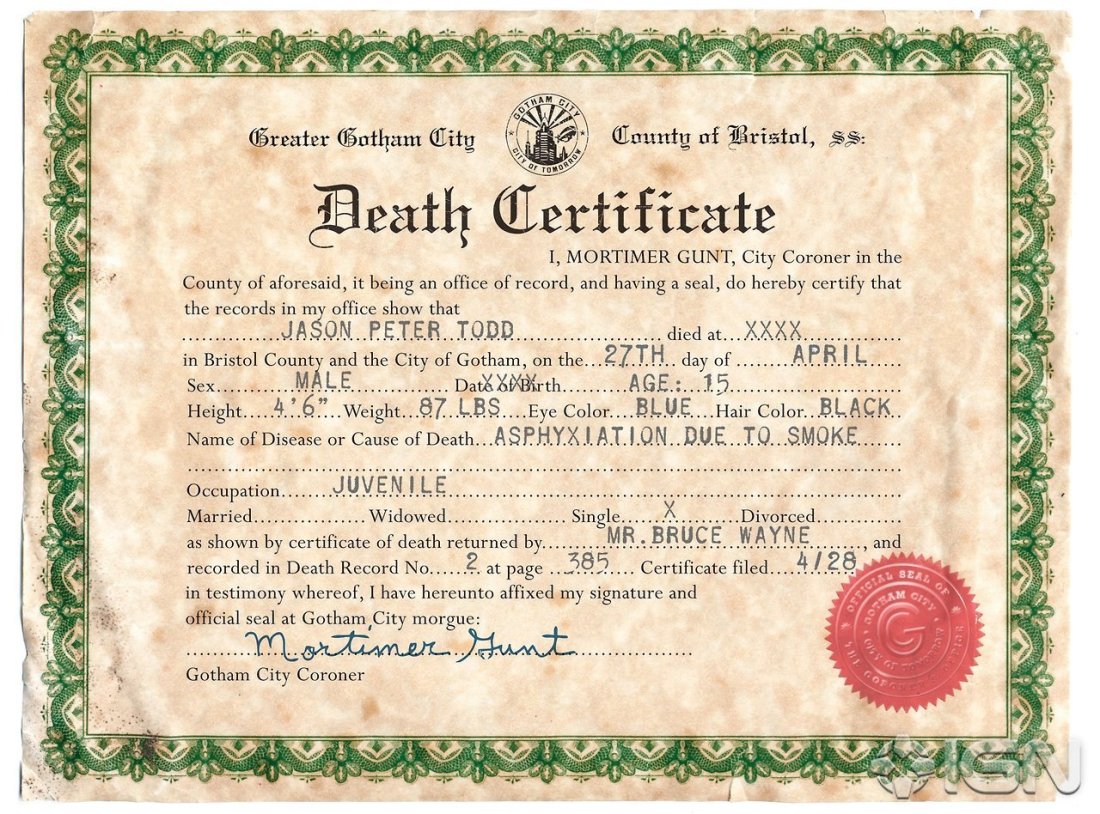
So, just a disclaimer, Jason Todd isn’t actually in the issue, but it does revolve around him. He hasn’t come back as Red Hood just yet.
Let’s just say that it’s reminiscent of the period immediately after his death when Bruce Wayne was noticeably more broody and brutal in his anti-crime spree than usual. Back then, the Bat Family was only composed of Dick Grayson, Barbara Gordon, Alfred Pennyworth, and a persistent young Tim Drake “auditioning” for a membership. This time around, their family has grown somewhat, and includes Cassandra Cain as Batgirl and Stephanie Brown as Spoiler.
Backstory (spoilers ahead): A new drug called G.H.D. is circulating the Gotham streets, killing some citizens, including a young female. Batman tracks down the supplier and throws him through a window several stories off the ground. Batgirl swoops in to catch the man, and Batman gets more information out of him through what his does best – instilling fear.
“How you hurt him. You were punishing him.”
After the bust, Cass calls Bruce out on his… unusual behavior.
That look on Bruce’s face in the third panel below… You just know that he can’t argue with her observation.
“It’s always personal.”
That cool detachment Bruce has? That wall he built around himself? All of it is meant to keep his mission from being compromised. His mission to protect his family, his friends, innocent lives. That’s the form of affection he’s developed over years of trauma and obsessive discipline to equip himself for this mission.
So, if he tries to shut down Steph’s aspiration to be a vigilante? It’s personal. If he tries to keep a brash young lady from jumping headfirst into the field without a parachute – the same way a fifteen-year-old boy once did? It’s personal. And, if you think he’s an unreasonable grumpy old man for doing it, he won’t fault you for begrudging him. (He’ll care, sure, but he won’t show it.)
“It’s strange. How he stops seeing them… the scars.”
This issue is actually entitled “Scarification”, and it seems that the next set of panels explains why. It’s probably this day, out of all the days in the year, that reminds him why his scars matter. Why everything seems to matter more.
“If this is about what today is, then… just know that I’m here if you need… to talk.”
I love how much the Batkids understand Bruce. Even if they know that it’s, more often than not, futile to appeal to him on an emotional level, they’ll keep trying anyway, knowing that he secretly needs them.
“Happy birthday, kid.”
Bruce harasses one more criminal before the set of panels below. He finally tracks down the supplier and makes him choose between taking his own lethal drug or jail time. (Guess which one he picks?)
It’s these last two scenes that gives the story its story. Bruce always has difficulty with expressing emotion, so it shouldn’t surprise us that sometimes it comes out as aggression.
On the day that reminds him of the son he lost to the thing they do, with another teenager wanting to be part of it all… must be extra hard, huh?
“For some of us there is no going back.”
This was a simple, but sweet tribute to Jason. A reminder that Bruce loved loves him and knew him well. That in his memory, Bruce is trying to keep from making the same mistakes.
(And, it was bittersweet how Cass “met” Jason for the first time like that… It gets better in the New 52′s Batman and Robin Eternal, though!)
I won’t go so far as to say that Dick Grayson is Bruce Wayne’s favorite son – let alone, child – because that will always be up for debate. After all, Bruce has a unique relationship with each of his children (biological or otherwise).
However, I do think that, among the Robins, Dick has the most complex relationship with Batman, even by virtue of his long tenure alone.
This set of panels from the New 52′s Nightwing #30 contains one of my favorite Bruce and Dick sequences because it give insight into their relationship as father and son. It’s one of the most dramatic (and brutal) ones I’ve read so far, but that’s part of what makes it memorable.
So, for starters, a little context (with some spoilers):
We all know that Dick is the original Robin, the one who set the standard for the ones to come. When he was beaten up by Two Face, Bruce “fired” him out of fear of putting the boy’s life in danger again. Dick eventually “outgrew” his scaly green spandex shorts to become the Titans’ leader and Blüdhaven’s protector, Nightwing.
As Nightwing, Dick’s a young adult who’s wise beyond his time and remains unbroken by all the trauma he’s faced. He also has a more “mature” confidence about him and often speaks to Batman as an equal (always with some level of affection and respect, though), something he’s earned over the years. Thus, it’s no surprise that, in over 75 years of partnership, they often butt heads over matters of principle. (Which fandom has tackled extensively in meme form.)
But this time (at the risk of oversimplification), we’re shown a fight between a child who put himself in harm’s way and a father who (quite harshly) reprimands him for it out of love.
Backstory: During the events of the Forever Evil story arc, the Crime Syndicate’s Superwoman reveals Nightwing’s civilian identity to the world, and everyone (except for Batman and Lex Luthor) thinks he’s killed. In the aftermath, Bruce sends him on a mission to infiltrate Spyral by posing as an agent. So, how did Bruce talk Dick into doing it? Read on.
“We need to do it again. You and me. I need to see if they broke you. I need to see if you still have the heart you once had.”
“I trained you to live, and I watched you die!”
Like a frustrated father, Bruce pushes Dick to toughen up. (He knew his son could take it. Or, well, that he had to.)
“Fight like you’re alive!”
Like a son afraid of disappointing his father again, Dick obeys and puts up a fight. (See that smirk on the second panel below? That’s the smirk of a father who knows that his son can surpass him and is proud of it.)
“They’re family! My family! I can’t do it to them… I just can’t.”
Now, while Bruce tells him about Spyral mid-battle, Dick is still trying to absorb the fact that Bruce is asking him to keep pretending to the rest of their family that he’s still dead.
They both hear each other, but refuse to listen. One is decided that their best option is to transform the situation into an opportunity to keep their family and other superheroes safe, over the emotional cost; the other, unwilling to break the trust that bonds them in the first place. This shows their fundamental difference in character: Bruce’s judgment is ruled by his pragmatism, while Dick’s, his sentimentality.
At any given time, neither of them is completely right or completely wrong. When they argue, the writers usually give them both a valid point of view. As an audience, we’re drawn to how they balance each other out, which was the main purpose the Robin character was created in the first place.
“We fall because someone pushes us. We get back up to push back.”
A son who feels betrayed by his father…
“I know I’m hurting you. My family. I’m making that sacrifice because I don’t give up. I don’t give in.”
A father who acknowledges it, but stands firm with his decision…
In Forever Evil, Bruce is clearly shaken when he thinks he’s lost Dick. (What’s that saying about how parents aren’t supposed to outlive their children?) He obviously can’t “fire” Dick anymore and he knows he can’t rein him in from crime-fighting either, so he mentors him one more time instead.
Bruce expects Dick to be the best man he can be and trusts him to be more resilient than other superheroes because, not only is it how Bruce and Alfred raised him to be, but it’s also how he naturally is. And, Bruce is desperate to equip him to be just that because he knows it’s possible with this son of his.
When I first read this issue, it broke my heart. Bruce seemed heartless, but he was actually focused on the bigger picture, which is true to his character. It was the sacrifice-a-few-for-the-good-of-the-rest spiel. Sometimes it’s almost as if he’d rather his children hate him and outlive him, than die on his watch.
As hurtful as it was, Dick relented and eventually became Agent 37. This from a man who has shown many times over the years that he’s fully capable of choosing his own path in spite of Bruce’s influence.
That’s how much he loves and trusts Bruce.
(Granted, perhaps DC just wanted to take espionage for a spin, but still.)
Bruce isn’t a perfect parent. Dick isn’t a perfect son. (Far from it.) Well, who is, anyway? But, every bone that broke that day made it clear how much they cared about each other.
Talk about “tough love”, huh?
This is about as interesting a segue as you can get into Grayson, really, which in itself deserves a separate post. It was an awesome series and Dick was really in his element in it. Plus, there are some brief, but beautiful Bruce and Dick moments in it, too.
Batman v Superman had nothing but terrible reviews, but Zack Snyder and co. have made it very clear that it wasn’t made for the critics, but for the fans.
Max, WhatCulture (”100 Easter Eggs in Batman v Superman: Dawn of Justice”)







 incorrect-batfamily-quotes